🎟️ Sightlines Actors’ Space Partnership, March 2026
You can join our Manila intensive at a reduced rate using the code below.
CODE: SIGHTLINES
almost 50% off
first 8 seats
🧑🔬 A unique approach based on 10 years of research into the first principles of directing,
grounded in a scientific methodology
👨🏼🔬 A unique approach based on 10 years of research into the first principles of directing,
grounded in a scientific methodology
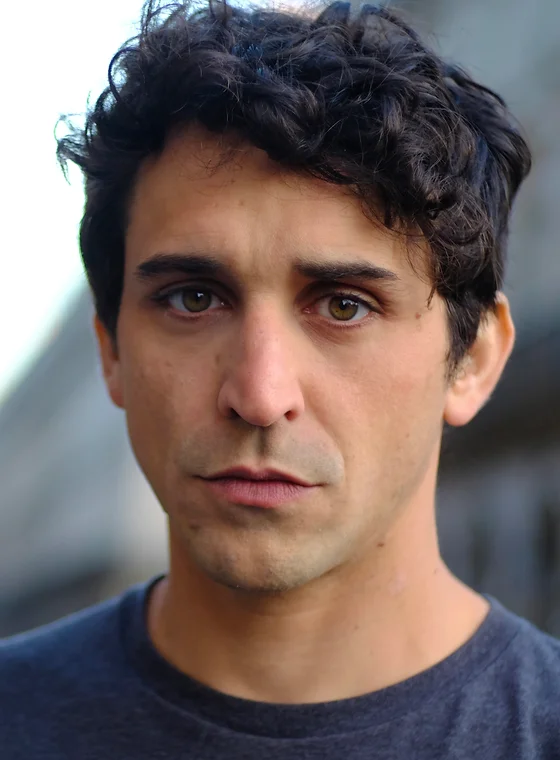
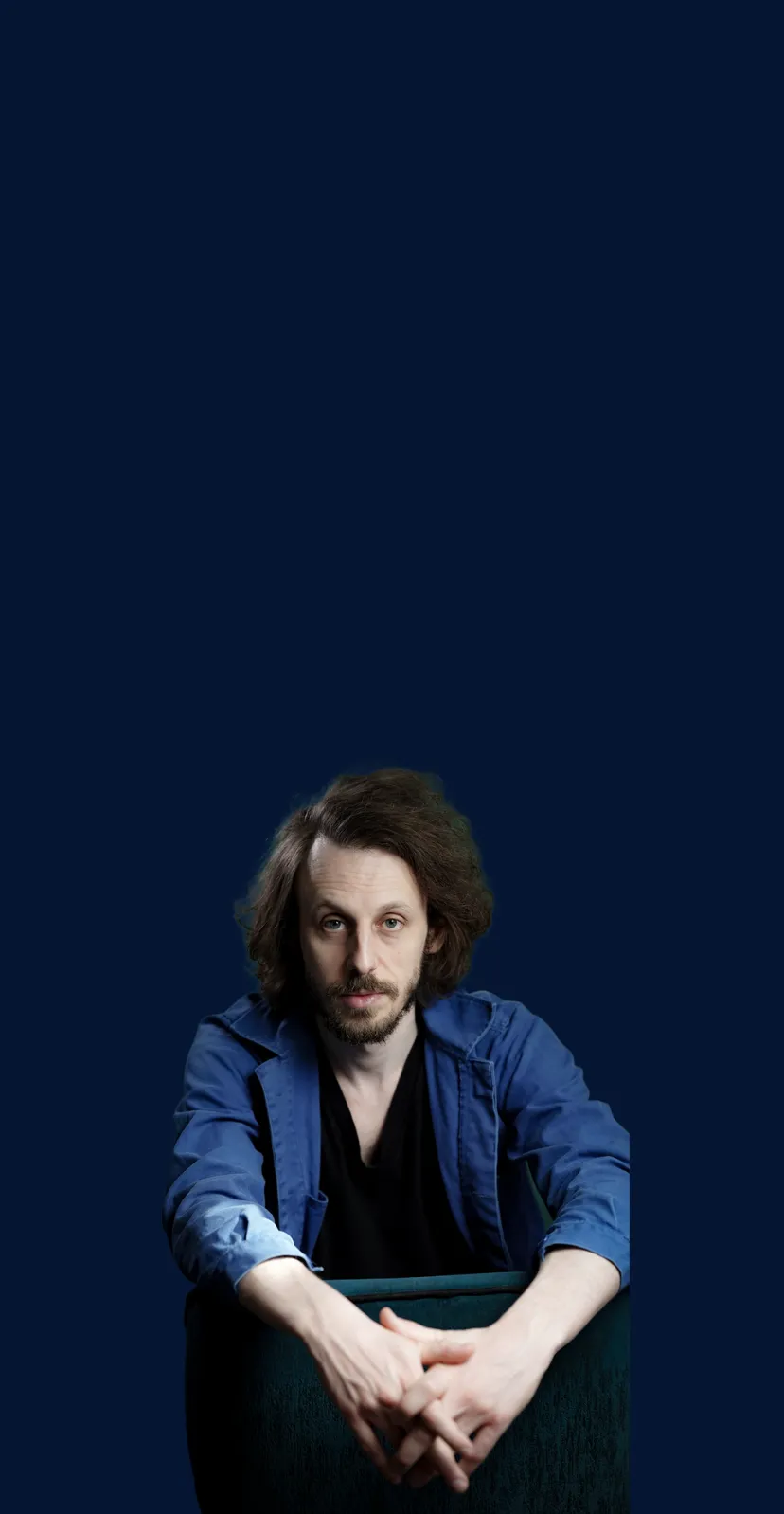
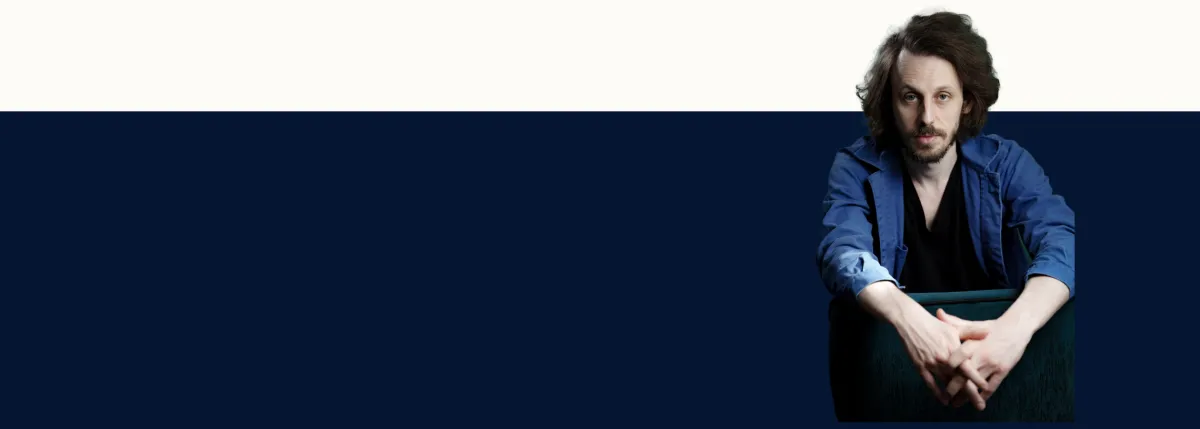
🤓 Octave Karalievitch
PROGRAM CREATOR
After studying science (mathematics and
physics in preparatory classes, then
philosophy of science and knowledge), Octave turned to
psychology and cognitive science, and
became interested in research in 3 areas in particular:
creativity, education and therapy.
Interested in the processes of personal development and self-liberation,
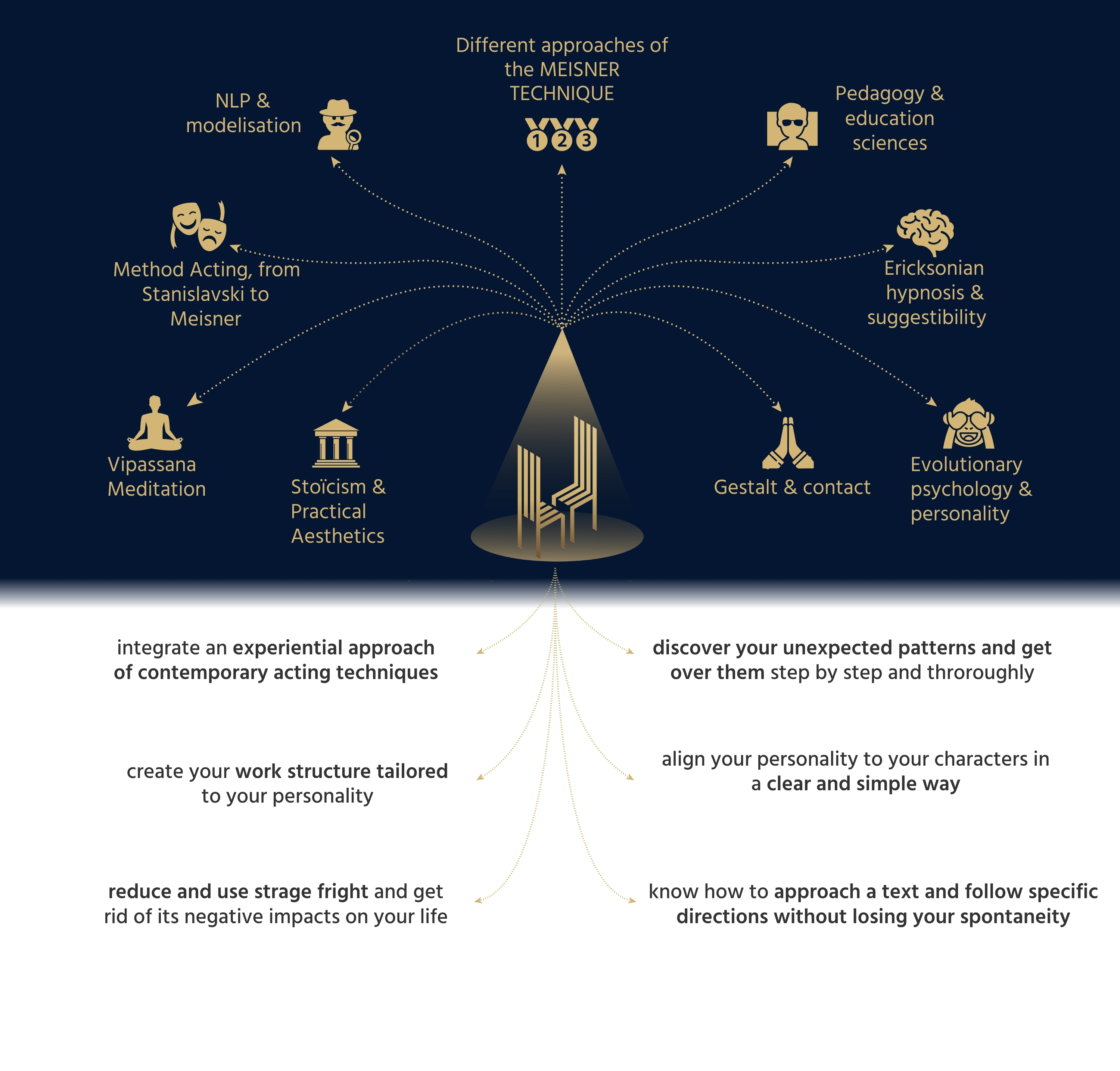
he also trained in contemporary tools of “brief therapies” and coaching
such as Neuro-linguistic Programming and
Ericksonian Hypnosis, both of which he is a certified
Master Practitioner by the Society of NLP.
After training as an actor, he discovered many Russian and American
techniques (among others:
Constantin Stanislavski, Stella Adler, Sanford Meisner,
Lee Strasberg, Eric Morris…) and it is the
Meisner technique that particularly attracted his
attention, beyond the unexpected sincerity that it confers on the actor,
by its healthy, playful and simple side.
Noticing from the start the links with his previous fields of study, he
also realized the variety of its approaches in the world. He then created
the Paris Meisner Studio to bring qualified teachers to
Paris, in order to continue training in the right way while exploring
complementary aspects of this technique, its history and evolution.
In his quest to perfect the understanding of the Meisner technique for
himself and other students, he set up a
novel system of research and development first called
Meisner & systemic coaching, before becoming the
First Principles Acting approach.
In parallel to his teaching and directing activities, Octave continues to
train in various related fields to enrich this research, having begun,
among others, a 5 year Gestalt therapy curriculum at
EPG, a certified trainer qualification and a
training in Brad Blanton’sRadical Honesty
tools (derived from Gestalt therapy and Ericksonian hypnosis, and aligned
with the development of the Meisner technique’s viewpoint work).
He also practices traditional meditation techniques and Buddhist
systems of mind body connection, especially Vipassana.
In 2022, Octave produced and
co-directed with Guillaume Caramelle the
school’s first short film,
C’est pas le Pérou!,
a comedy written by Aurélien Laplace. The film is available on
OCS, CanalPlay and
Amazon Prime.
🎟️ Manila, March 2026 intensive
🎬 9 sessions, 36 hours total
📆 March 9 to 13 daily & 17, 19, 21, 22
⌚️ 6 to 10pm (with a break in the middle)
We will move from clear theory, lab practice and feedbacks,
towards real directing situations, with each participant rotating between
roles: director, actor and observer.
DAY TO DAY PROGRAM
Day 1 | Frames, introduction to the OBP model and tools to communicate in an efficient and structured way.
You will learn models and explore practical structures from Neuro-Linguistic Programming (NLP) which will be used as a foundation for all the subsequent protocols.
Day 2 | Organic Suggestibility and introduction to Ericksonian hypnosis frameworks
You will learn to identify issues before they become rigidified, and to talk to actors in ways that helps them overcome their blocks.
Day 3 | The Contact Cycle roadmap and the Directing Decision Tree
You will learn to apply the tools from the previous sessions to each individual case, and follow a clear Decision Tree to diagnose what is the most essential problem happening and what to do next.
Day 4 | Working with text and Applied Calibration
You will practice accompanying actors on a simple scene, to experiment and get feedbacks on how to use all the previous tools in a first accessible professional setting.
Day 5 | Contact & suggestibility for scene work & directions
You will practice directing in pairs on the same couple of actors to help them be suggestible to their partners and themselves.
Day 6 | OBP Essence Decoding, Casting and directing strategies
You will learn to decode the behavioral essence of a scene, see how much each part matches each actor and so that your directions serve the scene’s structure in a way that is individualized.
Day 7 | Rehearsal traps and how to avoid them
You will identify the most common rehearsal traps and learn how to structure your work so actors do not freeze into fixed patterns that become hard to recover from. You will get to practice a new scene with actors and prepare them for the following day.
Day 8 | Directing actors on a shooting day and the Behavioral Evaluation Matrix
You will practice directing actors in simulated shooting environment and use the Behavioral Evaluation Matrix to evaluate what to do in faster and more stressful situations on set.
Day 9 | Integration, Ritualized Safety Protocols and your First Principles Directing playbook
You will review the whole framework, additional resources and closure exercices.
We will expand on Ritualized Safety Protocols and leave with a personal First Principles Directing playbook you can apply immediately, and keep coming back to.
⌚️ Enrolment closing soon...
🧐 Why most directions fail
❌
You’re telling actors what to feel but they start to push emotion, overact or indicate behaviour.
✅
THE SUGGESTIBILITY FRAMEWORKS
After learning to define precisely what you want in terms of the Observable Behavior at Play,
you’ll explore many different ways to understand and use what is happening for the actor right now in order to
let them get to the place you had in mind, organically and without indicating or forcing.
After experimenting with each concept and exercise, you will get a
complete synthesis of this approach:
a decision tree that breaks down every potential issue to its root cause, and provides a specific way to address it at the right level.
❌
The scene is technically fine, but it loses its soul.
✅
THE OBP ESSENCE DECODING
You will also receive the basic Text analysis approach breakdown, which is the most advanced framework we teach actors.
By learning to decode the Observable Behavior at Play in any part of a scene,
you will know what to direct actors towards so the essence stays clear, without micromanaging expressions, emotions or impulses.
❌
I’m not sure how to put actors at ease whilst directing them precisely, and how to build trust.
✅
THE RITUALIZED SAFETY PROTOCOLS
You will learn to define and set the different frames in which you interact with actors.
Communicating before, during, or after the scene involves different rules and constraints that must be clarified in advance.
There are pitfalls and great opportunities for actors to feel safe, reassured and free, without being pushed to “play it safe” in ways that do not serve the performance.
⚙️ All concepts will be introduced carefully and experimented on in practice, with video examples, so you get a very clear, hands-on understanding of each foundation.
🏷️ Admission
We will select candidates based on motivation and readiness to work quickly.
Recommendations from our partners allow direct enrolment.
💸Launch price:₱57,000
🐦Early Bird:₱39,000
🎉SIGHTLINES
₱29,000
best value
first 8 seats
🎫
Joining the program includes the full 9 intensive sessions with supervised practice.
It also includes additional online programs introducing the fundamentals of
Text Analysis, Casting, and Team Management on set.
🧑🔬 An intensive, step-by-step process adaptable to each person's
individual challenges, using our comprehensive approach.
🎟️
Grab it now for just
₱29,000
with the code
SIGHTLINES
≈50% OFFfirst 8 seats
👥 Limited slots, payable in instalments.
💬 TESTIMONIALS
“I had just finished a Meisner training at another studio and wanted to try the different approach offered at Paris Meisner Studio... I found a renewed sincerity in expressing my emotions and inner experiences... Octave’s precise feedback helped me discover emotional depth, a real presence on stage, and in daily life... I’m also happy to be surrounded by motivated people at the studio who are committed and help me grow through the rehearsals organized outside of class.”
“As a professional actor for nearly 10 years, improving my craft has always been essential. I first trained in Belarus, right at the heart of Stanislavski’s foundational work... Seven years ago, I discovered Sanford Meisner’s technique, and it was a shock. Paris Meisner Studio is the third place I’ve studied Meisner... I don’t ask you to take my word for it, but this is a true testimony: in just 3 months here, I learned more than in a year with other Meisnerians... More than in 3 years at Cours Florent. You’ve nailed it. I’m genuinely excited. Long live PMS.”
“As an improviser, I wanted to become an actor more grounded in the present moment. Octave’s inclusive and caring pedagogy not only helped me reach that goal, but also to improve in other areas, mostly related to acting, and also personally. In the end, the people who have something on stage are the ones who fully accept themselves in front of an audience or a camera… and I feel like I’ve been doing that much better since completing the Paris Meisner Studio training.”
“I was looking for authenticity and depth in my acting, and the studio’s program completely fulfilled my request. Sometimes, I come home from class feeling shaken and, to be honest, I love it. It is so common to leave the class feeling like you’ve touched something deep, and have something to work on until the next session. Our personal blocks are quickly brought to light, and Octave gives us appropriate work directions. That is when you realize acting can be therapeutic. What a gift. The journey may seem long, but progress comes quickly. Today, I can’t wait to test this new approach to text work in auditions and on set.”
“I was able to find stability in instability, which for me was a revelation. I no longer fabricate an idea of the scene or the character, I embody it in the present. This gives me confidence and a new sense of freedom in my acting for castings and shoots... The approach is deep and pragmatic... The work on texts and scenes is coherent and efficient... This Meisner and Systemic Coaching program is a solid holistic training. It is a human actor’s laboratory that allows us to build our own autonomy. A real revelation of our authentic lived experience. The classes are both enriching and caring.”
“Octave’s course helped me clarify the different approaches to repetition. In truth, depending on the teacher, the exercise can take very different forms. It was really confusing for me. Octave’s clarifications helped me understand both the differences and the similarities. What is essential, and what is not. I ended up having an experience that impacted me more than most of my previous activities, and in a shorter time.”
“Torn between the fear of overacting and the fear of not pushing far enough, I was also looking for an approach that would allow me to keep progressing without interfering with my current projects. The training at the studio matched exactly what I was looking for. I found exercises that brought my unconscious mechanisms to light and helped me gain sincerity. I rediscovered that spontaneity flows naturally when you are truly present with yourself and your partner, rather than clinging to preconceived ideas of characters or situations. Both the learning process and the text work are unlike anything I have experienced before, with incredible results.”
“The Meisner technique practiced at Paris Meisner Studio has greatly helped me in my craft as an actor. The teacher’s scientific approach is extremely efficient. Never a question left unanswered. Always precise, always kind. And even though I am not the kind of actor who wants to stick to a single method, I would still recommend every actor who wants to grow in their work to add a Meisner string to their bow. Partner work, presence.”
“In a very short time, I noticed a real evolution both on a personal level and in my approach to acting. On one hand, it helped me reconnect with emotions that had been buried for years, to get to know myself better by being sincere in my reactions, to receive honest feedback about the image I give, and to become more spontaneous. It is a process that helps you be more yourself, which is both liberating and joyful. On the other hand, in terms of the actor’s craft, building the work on who I deeply am gives me the sense of leaning on something solid, stable, and grounding. It is clear to me that this method allows for greater authenticity and depth in the way I embody a character, which is exactly what I have been looking for.”
“Paris Meisner Studio not only changed my acting, but also the way I interact in everyday life. I learned to understand myself better (what triggers me and how), so that I could choose whether or not to incorporate those reactions into my acting. I had taken several trainings before, some Meisner based, others not, and the Meisner and Systemic Coaching program allowed me to connect the dots and clarify the function of many exercises. Especially to understand, on my own, why some approaches worked and others didn’t. Thanks to this technique, I was also able to take a step back and observe both my own behavior and that of others, and to recognize certain patterns and dynamics in our interactions.”
🕵 A timeline of this research
Acting & directing epistemology, by Octave Karalievitch
🟢 Searching for true theory
My first area of focus after high school was in Science.
I studied Mathematics, Physics & Chemistry, and stopped my Master’s in Mathematics to start a Master’s in Philosophy of Science & Epistemology, and Cognitive Science.
The point of the scientific methodology is really to look for models that can accurately represent reality, that are predictable, and functional.
One of the best ways to get to that is to have a disposition where you (or your theories) are ready to be proved wrong in light of new information, what Karl Popper calls Falsifiability.
I studied scientific theories and their origins for 7 years in total from 2005 to 2012, and since I was hesitating, in high school, between science and literature, after getting involved in science first, I wanted to apply it to artistic fields.
I was interested in education (what and how to learn), therapy (how to change, beyond mere factual information, in a deeper psychological way), and creativity (what innovation is really about, and how to improve it).
I explored educational science, the psychology of creativity, and therapeutic approaches and their origins and modes of evaluation, but didn’t get into academic research yet, because I realized a lot of studies about, for instance, how to improve the way we learn, were already available but were not implemented in the French education system, so I decided to explore my own artistic career and projects first, and got back to music to work on my rock-n-roll album.
🔵 Searching for true practice
In parallel, I had started to hear about very powerful tools that had changed the lives of people I knew, in particular Anthony Robbins’ approach to coaching.
Tony Robbins is one of the most influential coaches of our times, and his approach is all about modeling what actually works with clear protocols, in a fast and efficient way.
I discovered that his philosophy mostly came from Neuro-linguistic Programming (even if he stopped his training early on, to create his own thing), which is a reductionist approach (decomposing things into smaller parts to understand their structure) created in collaboration by a mathematician and a linguist, Bandler and Grinder.
🧪
Despite not having been developed as a science per se, NLP is a pragmatic approach that has had a deep impact on coaching, therapy and learning techniques.
It was at times heavily criticized by competing approaches, partly because of how fast it was able to disrupt those fields, and also very influential and integrated in those same approaches.
Effects of those practices are often poorly measured, sometimes intentionally, given how traditional systems and their advocates function, but some quite extraordinary results came to light regarding Tony Robbins seminars, for instance, after a Stanford research team conducted a serious evaluation of their effects on depression and well-being, in a randomized trial based on his program DWD (Date with Destiny) published in 2022 in the Journal of Psychiatric Research (as well as a qualitative study based on Unleash the Power Within seminars one year before, by psychologists in the UK).
I used NLP structures, tools and general disposition many times in my own research, but disregarded a lot of its early temporary findings and claims.
I also integrated protocols from NLP and Ericksonian hypnosis in most of the teachers’ training to the First Principles Acting approach.
I completed a full training as a Master Practitioner, both in NLP and in Ericksonian Hypnosis. I started a long Gestalt therapy training years later as well.
NLP is also influenced heavily by Gestalt and Ericksonian Hypnosis, and I consider those tools and their philosophies some of the most powerful that exist today, both for getting results in therapy and coaching, and evaluating those results, as well as, in particular, teaching and directing actors.
It’s always been very compelling to learn those fields by practicing them, both as a practitioner and as a subject, and experience their structures and see their effects from the inside.
🧑🔬
In Neuro-linguistic programming, I did my final modeling thesis about what Stanislavski calls “the creative state”.
Joined by 2 classmates, we were interviewing actors, but also musicians and dancers, in order to model, with NLP frameworks, what worked best in their performances.
What beliefs or values they had around their work, what sort of rituals, routines, habits they had developed that were correlated to what they considered their best performances, or what they got the best feedback on.
The point of modeling a skill with NLP is to decompose it so that it can be taught, and we elaborated protocols from that research to get people in mindsets that were more conducive to better performances.
From that first early research and application in the field of acting, I realized that it was unlike music, or dance. As we get to play all kinds of characters, situations, emotions… this idea of a creative state can be problematic in itself.
There were still great things I got from it, interesting intuitions, paradoxes and commonalities. But I was very far from what I developed 10 years after, and I felt like I couldn’t go much further with those tools without learning more about what acting really is about.
🟠 Hiring acting “world experts” from abroad
As I was playing music with a group and also on my own at regular Open Mics to refine my craft, I wanted to discover actual frameworks and get more feedback to improve, besides the audience feedback you can feel in the room or talking with people after the set, not only in terms of music and interpretation, but in terms of performance.
So I went back to acting, which I had started in high school, with that in mind. I tried a few different techniques in Paris in regular classes for 2 years, mostly American or Russian inspired techniques in English (Stanislavski, Strasberg, Adler…), and then stumbled upon a first Meisner workshop.
I was just finishing my hypnosis certification in Montpellier, and came back to Paris a day late to start this workshop.
Right away, the technique struck me as having deep potential, very hypnotic qualities that induced something I had never seen anywhere else, from the first “repetition exercise”.
I liked how spontaneous it was, how we were working from what already existed, and both the alignment with what I was trained in, as well as what I saw in the work, made me feel like it was something I wanted to explore fully.
After this teacher stopped working with the organization that first brought him to Paris, and as he was looking for someone to organize the next ones, I started to organize so that I could attend the workshops for free.
🎥
Very early on I realized that acting techniques weren’t really well known, either by a lot of teachers who taught them superficially or in ways that seemed contradictory, or by students who didn’t know what to choose and why, or how to practice.
I therefore started to document some of what I was learning, when I had the time, online. You can find a few examples of this exploration on our English Youtube channel below.
📹 Interviewing my screen acting teacher Chris Mack, 8 years ago :
📹 Documenting a Free Class with my first Meisner teacher, Anthony Montes :
After a year or two of bringing him back to Paris, and rehearsing autonomously with classmates in between, I was also taking other regular classes, Meisner and Morris in particular.
I realized there were different approaches to the Meisner technique, so I worked with other teachers as well. In particular, quite a few teachers from Playhouse West in LA, one of Meisner’s last places of teaching.
I brought them to Paris for months at a time, so we could have regular weekly classes.
We had 10 classes per week, 5 groups having a class of 3 hours twice a week. I got to attend those classes, discuss with teachers about how they wanted their program to be presented, marketed, explained.
I also filmed most classes and translated for French students, set up additional resources, emails and summaries, for students who were struggling to grasp it all, and got to see, from the inside, how each teacher dealt with the technique from their perspective.
🎥
An extract from Ciera Danielle’s class on our French Youtube channel.
(One of the very nice and supportive teachers from PlayHouse West I got to work with).
I got disillusioned with many of the so-called (and self-proclaimed) “American experts” from “Hollywood”. I later even removed all content that was published about some of them, as I found their practice to be unethical.
I had issues both with the approach itself, and its efficiency (they were sometimes forcing on blocks, and as a trained therapist, I could see how counterproductive that was) despite saying they were individualizing the work.
I also found issue with the safety of the space they were responsible for. The natural rivalry that can occur when different teachers want to get to teach at the same place (in my school, in that case), brought out the worst of some of them.
I got to learn a lot about their characters, but also the political wars within schools in America, and the history of the technique (which they didn’t all know very well).
They were sometimes lying to the students, or having what I consider to be an abusive positioning as a means to preserve their authority in class, in particular as they were failing to respond to some difficult questions, or facing the students’ natural resistances to the work, as trying to be emotionally free and easy to read in public, whatever the technique might be, often puts them in touch with some parts they find hard to deal with (repressed emotions, personal resonances about how they always dealt with being observed by an audience, etc).
🎙️
Sanford Meisner's last teaching protégé Jim Jarrett mentions our work
🎥 The truth about Meisner history: our interview with Jim Jarrett
During COVID, I got to interview Jim Jarrett, Meisner’s last teaching protégé, about some of the history of schools, teachers, and the technique, to clarify other misconceptions about how Meisner teachers position themselves worldwide, and what the traditional technique is all about.
You can explore the chapters in the video description, and he mentions our school and research at those times:
After those emotionally exhausting entrepreneurial endeavours, and as I reflected on what I could learn from it, it seemed to me my personal role in all this would be more impactful if I created better systems that could be taught and scaled, instead of focusing on individual people’s shortcomings.
Everything we hear, worldwide, about cases of abuse either in acting classes or on set, I have come to believe, has a lot to do with the way this work is framed, or its lack of framing.
How people evaluate “authorities” or experts, and how little they know of the techniques and their effects, also contribute to letting unhealthy practices take place, for all parties involved, in that quite complex and unknown field.
As therapeutic approaches have evolved to require more intensive and precise training, as well as better evaluation frameworks, I took it upon myself to participate in clarifying publicly how all this can be set up and developed, in a way that is both effective and safe.
I started teaching, at first, in order to support students who were struggling in class, or leaving or about to leave, after what they experienced as personal blocks they couldn’t overcome.
It then gradually became a class of its own, and I named the technique Meisner & systemic coaching, as it followed a Meisner structure but drew from systemic tools for change, and other fields.
As the technique evolved and I clarified exercises and their names to reflect their updated protocols or new functions, and to avoid recurring confusions from actors who thought what we were doing was purely “Meisner”, the name of this research became First Principles Acting.
It is agnostic in terms of following one specific source or promoting one specific way, but rather focuses on the tools to evaluate and develop approaches, both for actors to be autonomous in their professional skill and for teachers and directors (or stage or casting directors as well) to know what they are doing.
⚪️ Custom made first film & students scenes
Teaching and directing aren’t exactly the same thing.
When you teach, you should optimize for the actors’ autonomy outside of class, whereas directing doesn’t require actors to be aware of everything that is at play in the exercises and their functions.
Too often acting teachers look for “good performances” in class to impress the audience and show the technique “works”, or for actors to “feel something deeply” from the inside so they keep paying for the class, because it seems impressive and makes them believe it helps push their boundaries, and therefore improve, from their perspective.
Directing, on the other hand, only requires that the actor gets to a certain place that the director is satisfied with, and this performance has to be judged, on set, from the perspective on what is in the frame, as well as needs for continuity between shots that might be kept at the editing stage, in terms of blocking, rhythm, intensity…
Unlike in acting class, the vision is very result-oriented and there isn’t such a pedagogical emphasis when dealing with actors.
However, a lot of the structures and tools are the same :
what works for actors to overcome their emotional blocks in class will also work on set if it can be used quickly enough
acting techniques and their effects will be the same
text analysis and directing performances will be the same
helping actors be legible and directable in terms of their Observable Behavior, and the effect it has on the audience, and how to measure it, will also be key in both cases
What we take time to explore and refine in class can be used very effectively, to the extent that the director is well trained in those tools, knows what he’s looking for and what can be used in each context.
🎥
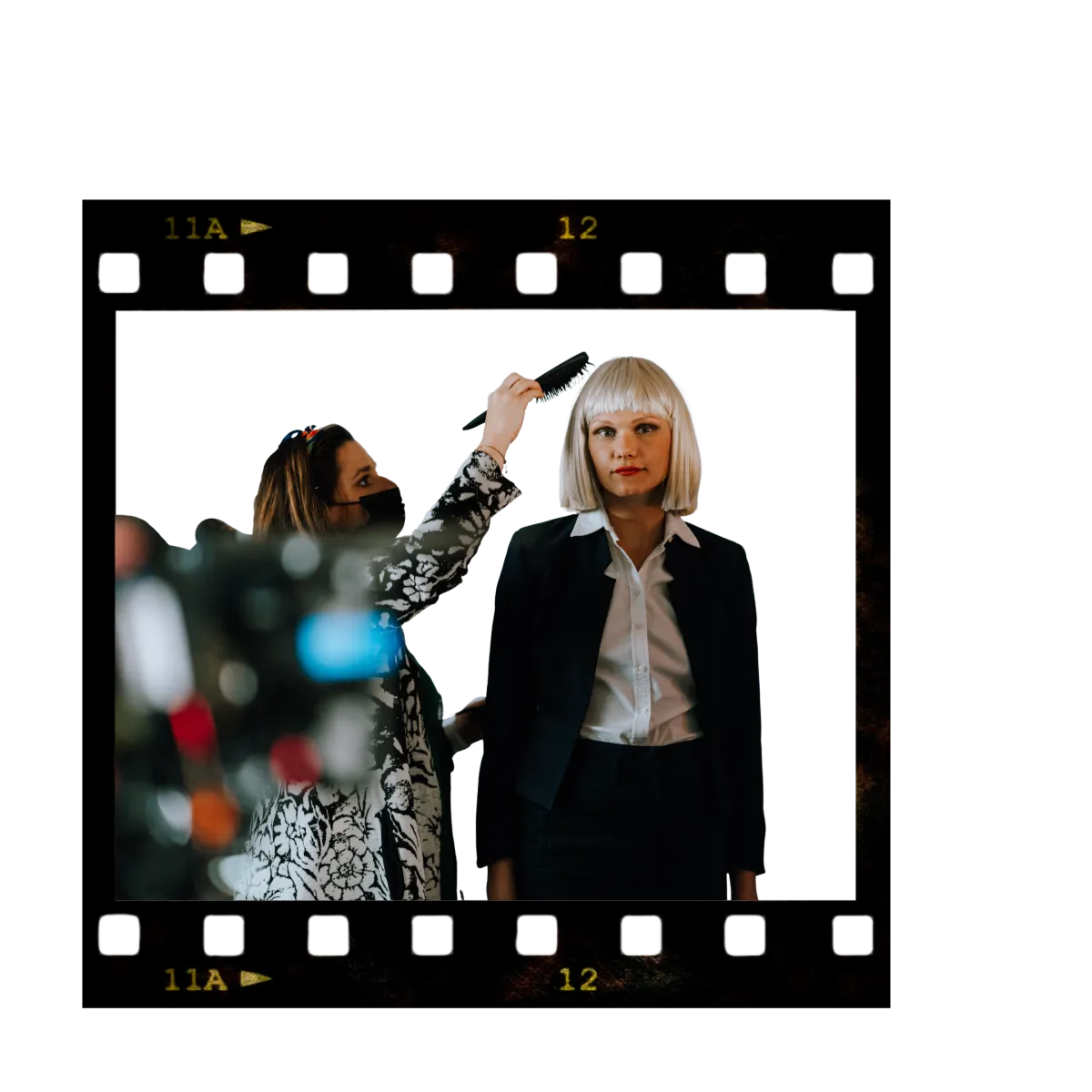
In order to test and promote this technique, and experience firsthand the differences between teaching in class and directing actors on set with the type of deadlines and stakes that happen on professional settings, I decided to produce a first “custom made short film” for a group of students.
I co-directed it with Guillaume Caramelle, and it ended up being written by Aurélien Laplace.
I was fully responsible for directing actors on set, and I got to learn a lot about how to adapt this research to directing.
In particular, working with a co-director on a script none of us had written required subtle adjustments, so the style of the writing as well as the visual narration could align with natural acting choices. In this case, for a very peculiar type of comedy.
The film, “C’est pas le Pérou!“, ended up being bought by OCS, and available on Amazon’s Prime Video as well as CanalPlay.
🔮 We can’t talk about this scene without spoiling the story, but a private link can be sent on request to see the full movie.
🎥
We also had end of trimester students scenes that we filmed as exercises for the actors, with much more extreme timeframes than what is usually possible on set.
Instead of having one day of shooting for 2 to 3 “useful minutes” of final standard time, we shot 2- to 7-minute scenes in 30 to 45 minutes for each, in one or two takes for the actors, from what they had rehearsed in class.
🎬 French version of a scene from The Master :
in 1 take alone for the close up, and 1 other take for the larger shot, used for a few seconds at 0:40 & 2:15 - 40 minutes for set up in total
- English subtitles available in the video settings
❓ Frequently Asked Questions
You do not need years of experience, but this is not a casual discovery workshop.
If you are completely new to directing actors, whether on stage or for any type of filmed project,
you can talk with us
so we can check together if it is a good fit for you and how to approach it.
In any case, everyone will start from zero with this specific method of directing actors,
and additional resources will be given to those who want to accelerate their directing career after the workshop.
You do not need to submit an audition tape. You may register directly and secure your seat.
After payment, we simply verify that every participant is ready to engage with the pace of the training,
so the group stays focused and motivated in order to get to scene work quickly.
If your application is not the right match for now, we will refund you in full in case you have already paid a deposit.
You can book a free orientation call if needed.
People recommended by our partners can usually enrol directly, as long as there are seats left.
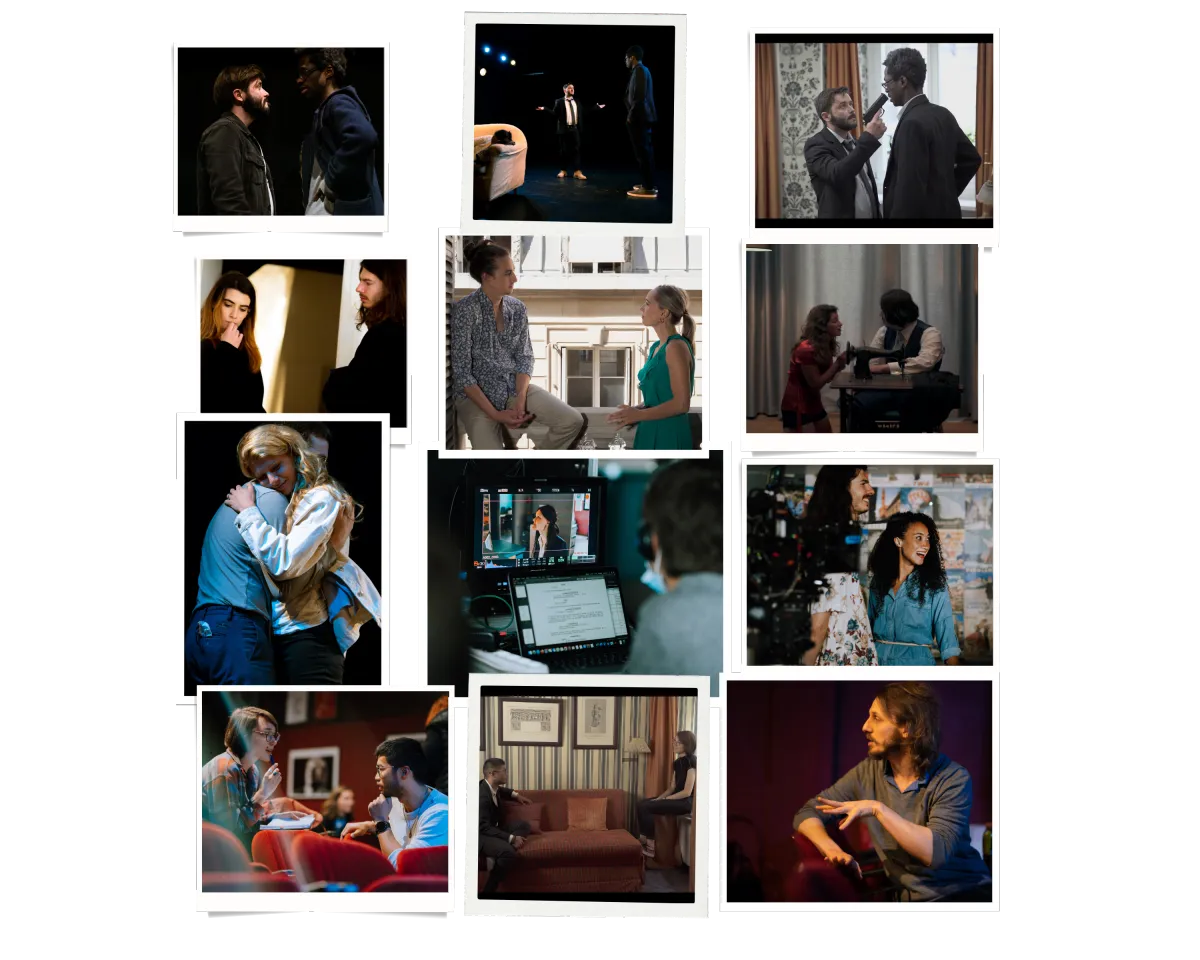
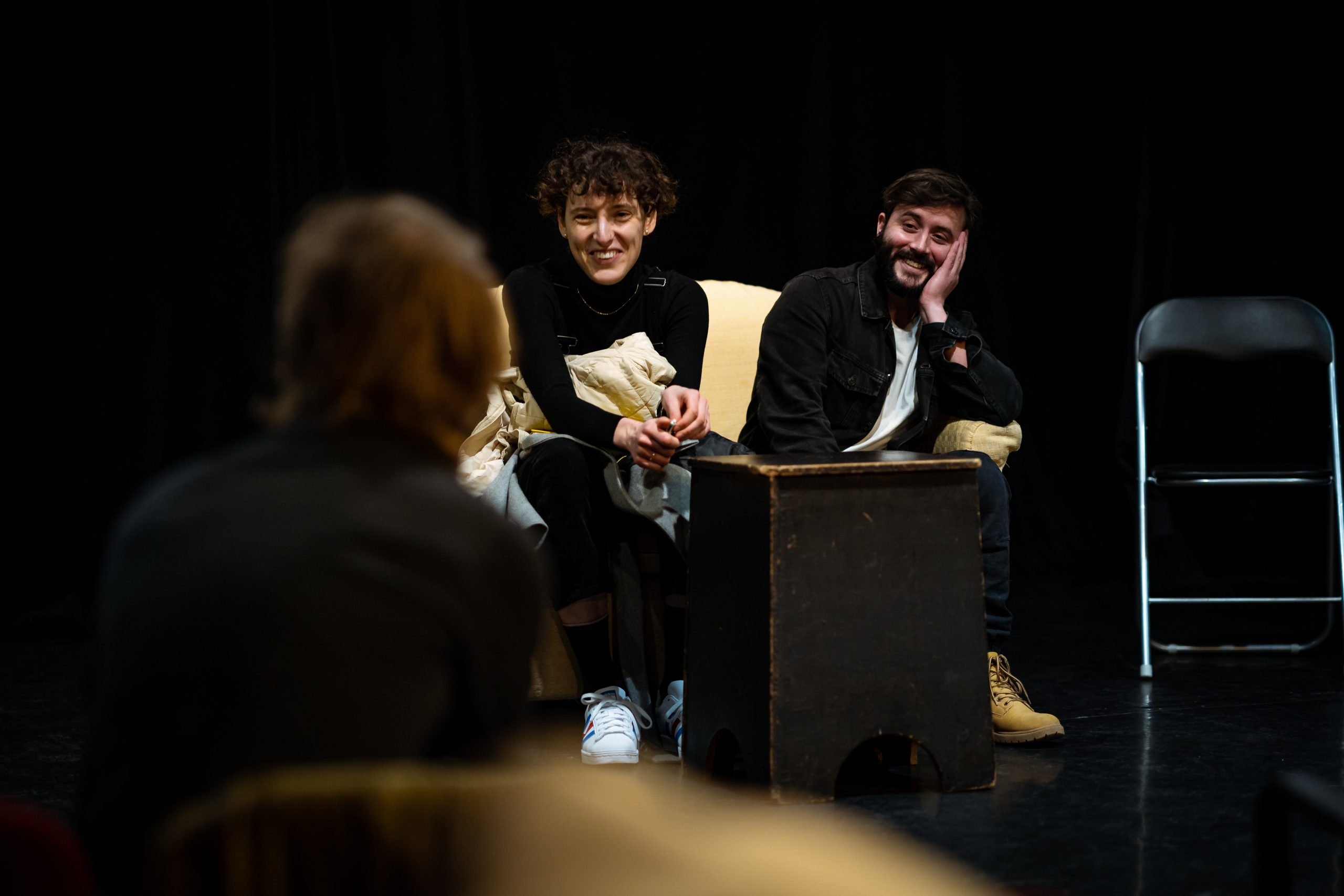
Yes. In the first sessions, you will practice inside the group and rotate between the roles of director, actor and observer.
Later in the program, we invite professional actors so that you can direct them in conditions that are closer to a real shooting day,
with time pressure and higher stakes.
Yes, at some moments you will also act. The goal is not to turn you into an actor, but to let you feel from the inside what a direction does to you,
when it helps and when it blocks you, so that you can adjust the way you direct with much more precision and empathy.
Each session combines short theory, clear demonstrations and a lot of practice.
In a four hour block, you usually have two practice sessions where you apply the tools in pairs or in small groups, with supervision and feedback.
You always know why you are doing an exercise, and you test it immediately.
Yes. The whole program is designed so you can use it right away in rehearsal and on set.
You leave with a First Principles Directing playbook, the Directing Decision Tree, the Behavioral Evaluation Matrix and written protocols that you can keep with you.
You also get online resources and reminders, so it is very easy to integrate the tools in your next project.
Very much. The tools focus on observable behaviour, clear communication and safety, not on abstract acting jargon or any presupposed general technique actors should know.
Whether actors have had training or not, they will never be trained in the same way, and all have different personalities and casting types.
You will learn how to navigate each person's blueprint quickly in order to make the right choices and communicate efficiently and safely.
You can pay the full amount at once, or in several instalments.
For the launch edition in Manila, we also try to find solutions for people who are very motivated but need a bit of flexibility,
so you can contact us if you need a specific payment plan.
🙋 Any pressing question? Feel free to ask here.
Join the team
Help us organize locally & get a free spot, or let's discuss partnerships.